


 English

While 3D printers are themselves additive manufacturing systems, they also almost entirely rely on precision CNC machine parts. Lead screws, shafts, eccentric nuts, timing pulleys, aluminum brackets, spacers, bushings, and custom-made fasteners provide the heart of many successful printer assemblies. As printers become more advanced- especially industrial and special motion platform printers- "stock" commercial hardware doesn't always match the demands for tight tolerance, smoother surface finishes, and increased batch-to-batch consistency, and that is where custom CNC machining can help.
CNC turning and milling, Swiss and 5-axis machining support custom aluminum, brass, stainless steel, and engineering plastic parts produced from engineering drawings. Tight tolerances, concentricity, surface finish, thread quality, Material properties, and assembly clearances all need to be considered for precise CNC fabrication. CNC 3D printer critical parts, their functions, tolerances, material selection, and CNC manufacturing best practices for desktop, industrial 3D printers and CNC routing.
1. Why Are CNC Machined Parts Important for 3D Printers?
A 3D printer deposits material into a specific shape to generate an object. For good 3D printing, the movement must be repeatable and precise, and tiny variances in key moving parts can cause problems.
Motors, lead screws, shafts, and pulleys provide motion to the print head and build plate. High-quality CNC components are used to maintain alignment of assemblies. Runout in the lead screw and shafts, and the use of ill-machined shafts cause positional error in the assemblies, while Custom Shafts, spacers, and mounts keep the assemblies in correct geometry.
Minimize mechanical vibration: At higher print speeds, vibration can be a major contributor to print quality issues. Precision-machined pulleys, couplings, and brackets all eliminate the slack caused by loose or mismatched parts and misalignment.
Assembly ease: Dimensional repeatability within and from batch to batch should remain consistent so that it is easier to assemble and replace parts in your OEM customers' designs using your custom hardware.
Custom frame designs and motion systems often need non-standard parts such as aluminum mounts, specialty eccentric nuts, or unusual threaded shafts. CNC Machining can work with you from a new product concept to finished design.
2. Important CNC Machined Elements of a 3D Printer
3D printers contain a lot of parts, and most of those parts are machine parts. At the same time, a set of precision CNC machine parts accurate the motion, assembly, and performance of the many structural parts.
Lead screws Small diameter high precision leadscrews to position the Z axis. A stepper turns the screw, resulting in the print bed/hotend moving linearly. The thread should be good quality and have a defined profile, pitch, diameter, straightness, runout, and surface finish. Cheap leadscrews will jump around and jerk, so they will induce drifting and vibration. CNC turning and thread cutting can produce any profile you need.
Timing pulleys: Drive X / Y axes using toothed belts. Tooth form, pitch, bore, and run-out need to be compatible. Custom CNC Pulleys help avoid belt slip and erratic motion if bore, mounting, or tooth specifications are off specification.
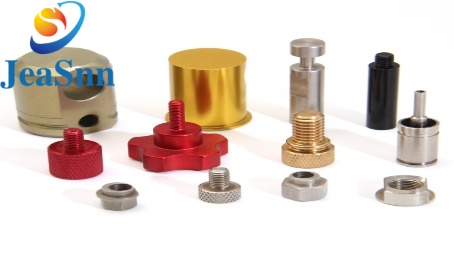
Eccentric nuts: Use with V-groove wheels for roller preloading against the extrusions. Accurate eccentric offset, OD, hole locations, and threads allow easy, consistent adjustment of the gap.
V-groove wheels: Travel in aluminum extrusion rails for CNC router frames and gantry systems. V-groove geometry is fully tested, as well as the concentricity and bearing fit; bodies of aluminum or engineering plastic.
Provides stiff support for assembled units. CNC milling to machine datum flats, pockets, and threaded holes for specialized printer and router frames.
For moving parts, install Link lead screw assemblies. Custom shoulder screws, thumb screws, and standoffs can be turned, milled, and tapped.
Shafts, bushings, spacers, and sleeves handle alignment, spacing, and support. ID, OD, length, concentricity and surface roughness are controlled to maintain clearance for assembly.
3. Material Selection CNC Machined 3D Printer Components
Material selection affects part weight, strength, wear resistance, machinability, and cost and should satisfy each part's mechanical requirements.
Aluminum alloys: 6061, 6061-T6, 6063 and 7075 are popular. Lightweight, a little harder, but easily machined and anodized. 6061 is used for standard brackets, mounts, and plates, while 7075 is used when you need stronger structural parts.
Stainless steel: With strength and corrosion resistance, 303 is designed with easier machinability for precision-turned parts, with 304/316 applicable for shafts, shoulder screws, wear-resistant pins, and more.
Brass: Excellent machining for complex threads and close tolerances. Suitable for eccentric nuts, threaded inserts, small fittings and custom threaded hardware.
Plastics for engineering: POM with low wear and permanent shape for bushes and slide rollers. PTFE with ultra-low wear and chemical resistance for special functional components.
This culmination takes into account working temperature, load, friction, service life, and production budget.
4. Important Tolerance Requirements of 3D Printer Components
Tolerance Control is critical for CNC 3D printing parts. You don't need to be expensive to use all the features to one specific tolerance.
In all major critical features, every possible effort has been made to keep dimensions - for example the diameter of the shaft, the seat bores, pulley bore, location of holes, threads - as close to the absolute minimum tolerances as possible. Toleranced and geometric features can be as tight as ± 0.005 mm depending on material, geometry and machine conditions. Tolerance is calculated on an individual case.
These are used for rotations of shafts, pulleys, couplings, etc. They have to be kept as if they are very big, and if they are moved, then they will become loose and thus the purpose of the device will be vibrating.
Lead screw and fastener thread accuracy, pitch, depth, and tolerance class should be mentioned to eliminate the possibility of slack or backlash in the system.
For reduced friction and wear, shafts and bushes require a much finer surface as well, depending on how the component is being used.
Flatness and parallelism: To mount the plates and brackets so that the system does not contain empty space, and to maintain the movement in the system.
5. 3d Printer Parts Machining Processes For CNC
Part dimensional-completed- CNC process dimension, would increase the milling accuracy and the cost.
CNC turning: Specifically designed for round parts like custom shafts, lead screw blanks, spacers, bushings, and other custom nuts. Capable of reliably machining all diameters, lengths, and rotation characteristics for your round hardware.
CNC milling: It is used for parts with flat surfaces, slots, pockets and complex profiles, producing spindle mounts, brackets, nut blocks and plates, supporting custom designs and prototype development.
CNC Swiss Machining: Ideal for manufacturing small precision parts such as pins, small shafts, and threaded parts. The CNC Swiss Machining process provides assurance of quality for large production runs of small parts.
5-axis CNC Machining: Performs on complex parts with edges that are angled to the surface. It minimizes the re-fixturing and ensures geometric accuracy for special features of the design.
Custom Drilling, Tapping & Assembly: Drilled and tapped. Secondary machining services may include deburring, finishing, and other finishing services, and we can provide this as a combined package.
6. Product Defects and Production Difficulties and Their Prevention
Tiny marks from the machining process may prevent parts of the 3D printer from fitting together, and they may also influence their functionality. The issues listed below are among the most recurrent, and you can learn how to prevent each of them.
Wrong diameter of the shaft: this is a faulty fitting of the bearing. It was resolved thanks to the best CNC turning with dimensional analysis.
Pulley runout: Failures of Runout, Motion vibration. The control concentricity and runout inspection.
Wrong thread pitch: will not go through assembly. Use serviced equipment to cut threads and for thread gauge.
The burrs around the mounting holes Cannot be attached. Burr grinding and edge finishing.
Surface finish: increases wear and friction. Optimization of machining parameters and finishing.
Material work deformation: will change the dimensions. Use the fixturing and the cutting as required.
Preventive QC is more reliable than final inspection. Lock down critical dimensions on engineering review. Confirm inspection process prior to high volume manufacturing.
7. Quality Inspection for Custom CNC 3D Printer Components
The inspection process ensures a part is manufactured according to engineering specifications. A quality supplier will be concerned with each step of the process, including material qualification, dimensions, thread quality, surface consistency, and lot-to-lot stability.
Dimensional inspection: Calipers, micrometers, bore gauges, thread gauges, optical testers and CMM are used to measure all critical dimensions for conformity to drawings.
Material certificates and incoming control of incoming material. Confirming the grade and temper of the raw material aluminum. Confirming the material composition of steel and brass.
Surface & visual checks: Burrs, scratches, and tool marks are inspected on parts. Anodising, polishing, and other finishes are tested to meet specification and have the desired appearance.
Batch consistency: Dimensional tolerances for 3D printer OEMs should be consistent between batches. Consistent process control and inspection records can reduce the difference in dimensional tolerances and improve ease of assembly.
8. Customized 3D Printer Parts CNC Machined by Jea Snn
What are the criteria for choosing the best 3d printer CNC Suppliers? Which factors to consider?
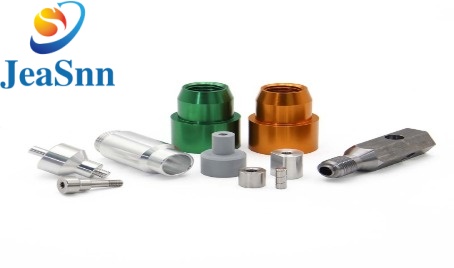
What they produce: Custom aluminum extrusions, structural shapes, and mounting brackets; aluminum structural frames, mounts, and brackets, including extruded aluminum hardware; various turned parts, such as lead screw assemblies, spacers and shafts; special fasteners, including thumb screws, eccentric nuts, standoffs and keyed coupling shafts; and aluminum bushing and nut blocks.
The processes we use to manufacture for you: CNC turning, milling, Swiss machining, 5-axis machining, prototyping, and assembly. We manufacture with aluminium, brass, stainless steel, titanium, POM, and PTFE.
We have over 20 years of precision manufacturing expertise with ISO 9001:2015 and IATF 16949:2016 certification, helping produce everything from prototypes through to high-volume manufacturing in accordance with customer drawings and material/tolerance requirements.
9. How to request a quote for Customized 3D Printer Parts
Video speeds up quote for 3D printer CNC custom and replacement 3D printer CNC parts - technical specifications In order to:
2D dimensional drawings with tolerances, thread details, and geometrical requirements
3D STEP/STP CAD files for structural review
Defined material, surface finish and order quantity
Critical tolerances of fits of the bearing and tolerances of shaft and pulley bores.
Application notes covering installation and working conditions
Samples or initial prototypes are accepted when there are no drawings available. DFM Engineering evaluates the drawings for machining.
Conclusion
The mechanical part of a modern 3D printer is mostly machined using CNC.
Motion precision & stability are secured by key parts such as lead screws, pulleys, eccentric nuts & mounts.
Material selection, tolerances, concentricity, thread quality, and inspection all matter for the outcome.
Jea Snn Hardware is able to make custom CNC parts and spares for 3D printer OEMs by turning, milling, Swiss and 5-axis machining. Please contact us for a quotation.
Get in touch with Jea Snn Hardware for Custom CNC 3D Printer Parts
Searching for a Custom 3D Printer Parts Manufacturer, Aluminum Precision Components, and CNC Machined Shafts or other Custom Mechanical Hardware?
JeaSnn Hardware. Please send us your product design drawing, CAD drawing, or sample for us to work on pricing and product development.
Website: https://www.cncpartschina.com/
Email: engineer@cncpartschina.com
Phone / WhatsApp: +86 189 9805 7602
Send us your drawings today. Our engineering team is ready to help manufacture precision CNC parts for your 3D printer and CNC router projects.
Explore CNC machined 3D printer parts, including lead screws, timing pulleys, shafts, mounts, materials, precision tolerances, and custom manufacturing.