




 English

Designs of electrical, power, and electronics applications are where you will most often see brass CNC machined parts being used as connectors. These parts build a physical and electrical bridge in these processes to ensure predictable functionality over a wide range of operating conditions. As these products are still miniaturising further, the demand for custom brass CNC machined parts with, for example, specific thread sizes, dimensions, and robust connectors and conductive properties will increase. While standard off-the-shelf solutions can be used, CNC Machining offers a more flexible solution.
The key properties of brass are high electrical conductivity, suitability for CNC machining, good corrosion resistance, and mechanical properties. Through the use of CNC lathes and mills, a large variety of custom brass electrical terminals, contacts, threaded components, etc. can be manufactured.
However, there are several other factors when designing and manufacturing connectors to consider, such as current rating, voltage drop, heat dissipation, finish and fit, coating, application, etc. This article provides some pointers to help you get the best out of production runs for your designs and the designs of your customers.
1. Benefits of using Brass for electrical and power connectors
There are 4 principal advantages to the use of brass:
Conductivity - Although not as high as copper, brass provides very good conducting ability. When considering overall suitability of a metal for the connector in question (conductivity, tensile, machinability), it is a strong contender.
Machinability - Brass has a very favorable cutting characteristic for both lathe and mill operations. A large variety of complex shapes and custom features can thus be readily produced to fine tolerances for the required application.
Resistance to oxidation and corrosion - Most enclosed and factory-based environments will allow the natural properties of brass to perform adequately. Application of Ni or Sn coatings will extend this, but exposure to Ammonia, H2O and salts should be evaluated.
Strength and longevity - There are several suitable brass alloys with appropriate levels of yield and tensile strength to facilitate the forces applied during fitting and multiple plug and cycle, whilst ensuring good, uninterrupted connectivity.
2. Examples of Brass CNC Machined Connectors
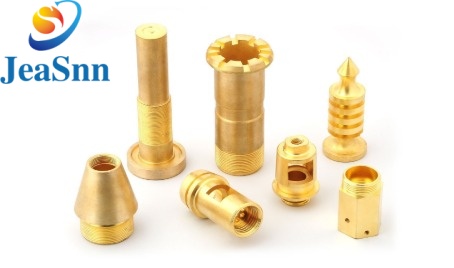
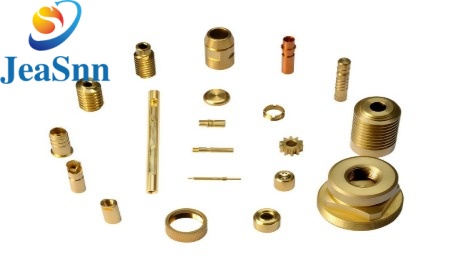
As above, any shape and form can be CNC machined from brass to suit a given drawing and means of interconnection in an electrical or power environment. Some typical items include:
Terminals - to terminate wires, cables and connect to other plant. Will typically require one or more tapped holes, means of fixing and an exposed contact face. Close dimensional accuracy facilitates quick and easy integration.
Threaded pieces - Extensively used throughout industrial plant and instrumentation. A number of parameters need to be defined (nominal, lead, depth and tolerance). Turning is very well suited to generating the required geometry.
Contacts - Typically incorporated into connectors, switchgear and PCBs. A high degree of accuracy and suitable profile and finish are essential, and degradation due to plating loss and wear will dictate life in many cases.
Bushes and collars - To provide alignment and retention of other elements. A high degree of true running will be necessary, readily achieved through CNC and Swiss processes.
Inserts and screws - Required to fix elements within injection-molded enclosures and general electrical units. Further bespoke items such as spacers and fasteners can also be supplied.
3. Material Selection: Which Brass Alloy Is Suitable?
Proper brass alloy selection is critical to meet targets for electrical performance, mechanical strength and machining efficiency, as different grades vary in conductivity, machinability, corrosion resistance and strength.
Free-cutting brass: Optimized for high-efficiency machining, ideal for intricate precision parts such as small connectors, threaded fittings and terminals. Note its lead content for regulated electrical applications.
H59 & H62 brass: General-purpose industrial brass with balanced strength, machinability and corrosion resistance, widely used for threaded connectors, mounting parts and regular electrical fittings.
H65 & H68 brass: Higher copper content delivers good conductivity and ductility, suited to parts needing a balanced electrical and mechanical performance.
Low-lead brass: Required for lead-restricted scenarios. Manufacturers need to verify material composition and compliance certificates prior to production
4. Critical Design Requirements for Brass Electrical Connectors
A certified brass connector must meet requirements for mechanical and electrical specifications.
Conductivity and contact resistance: On electrical parameters, conductivity affects a connector's current-carrying capacity, and contact resistance also directly leads to heat generation. Designers need to consider contact area and surface condition, contact pressure, plating (type and thickness), working current, and temperature. Increasing the contact area reasonably and ensuring constant contact pressure will lead to lower resistance; lead resistance and temperature rise tests should be carried out according to the standard.
Dimensional tolerance: Any deviation of dimensions also affects assembly and contact performance. For reference, essential parameters of connectors include inner/outer diameter, thread type (size and pitch), length of contact pin, contact hole position, concentricity and surface flatness, etc. CNC turning and milling make the dimensional tolerances stable, and all these tolerances should be indicated on the drawings clearly according to their working function. Thread structure and connection reliability: Connectors with threads require engagement to be made tightly. The type and pitch of the thread, the length of engagement, and tolerance have a great effect on the quality of the connection. Improper thread design may result in loosening and difficulty of assembling or even thread breakage; it can be achieved by CNC turning and tapping.
Power transfer performance: Current flows, which generate heat. Overheating causes the premature failure of the contact and plating materials and coatings. Engineers need to consider the current load and contact resistance, ambient temperature, heat dissipation, and contact pressure. Thermal tests are necessary for high-current connectors.
Environmental resistance: Connectors may be exposed to environmental factors such as high humidity, dust, chemicals, and temperature change. The materials and surface treatment of connectors are related to their working condition. Tin plating and nickel plating are common finishes; coating should be compatible with the contact's working performance and comply with regulations.
5. CNC Machining Processes for Custom Brass Connectors
Machining depends upon connector shape, volume, and tolerance.
CNC Turning: Excellent machining method for brass parts with a pipe shape, such as threaded fittings, contact pins, and precision sleeves. Precise control of outer diameter, bores, and threads can be achieved.
CNC Milling: Use this for machining flat components, slots, mounting holes, and detailed features. It is a standard process used during the creation of custom brass terminals, mounting brackets, and connection blocks.
CNC Swiss Machining: Designed for machining small, complex brass components. It provides high productivity and maximum precision, and it is ideal for miniature contact pins and connectors.
Creating holes and threads for screw assembly, electrical cable attachment, and mechanical assembly. Proper toolings and feeds during drilling and tapping will result in minimal burr formation and high-quality threads.
6. Quality Control for Precision Brass Connectors
Quality inspection is required for machining custom CNC brass connectors to ensure the product reaches the engineering standard. The inspection standard should be agreed and determined before mass production.
Material checking: Hardness testing, brass alloy chemical composition, material certificate. For the low-lead brass and special material part request by customer is very essential.
Dimensional inspection: Different verniers, micrometers, thread gauges, and CMM are used to measure the critical dimensions to verify the tolerance of the dimensions from the drawing.
Surface quality inspection: Make-up assembled parts to check if there are any burr, scratches, machining marks, plating blemishes, etc surface problems that will influence contact or assembly.
Electrical & mechanical property test: Electrical tests are resistance, contact resistance, conductivity, and temperature rise. Mechanical tests could be additionally used to ensure that the assembled connection is stable and rigid to operate for a long time. The acceptance criteria and test procedures should be negotiated between the two parties before the production of these test items.
7. Custom Brass CNC Machining Solutions by JeaSnn
Collaboration with a reliable CNC machining provider ensures the smooth rise of custom electrical parts. JeaSnn Hardware provides you with OEM and ODM high-precision metal and plastic parts for electrical, electronic, automotive, lighting, and industrial machinery.
We design and produce custom electrical connectors made of brass, terminal pins, contact parts, fittings, bushings, sleeves, insert nuts, screws, hex standoffs, and all kinds of threaded components. Several brass alloys such as H59, H62, H65, H68, H70, HPb59, and C360 can be tailored to meet project specifications.
In our workshop, we provide the following CNC machining Capabilities: turning and milling, Swiss machining, 5-axis machining, prototyping, and assembling. We manufacture aluminum, stainless steel, and plastic machined parts, as well as Custom Shafts, bushings, spacers, and fasteners.
Quality & capacity: For more than two decades, we have been experts in precision manufacturing and are ISO 9001:2015 and IATF 16949:2016 certified. From prototype validation to mass production, we provide one-stop custom manufacturing support.
Conclusion
Connectors machined in brass for electrical and power systems. High conductivity, mechanical strength, corrosion resistance, and high machinability are key features of machined brass connectors. In designing connectors, material selection, contact resistance, dimensional tolerances, thread structure, thermal performance, and surface treatment must be taken into account.
We can customize the machining of brass terminals, threaded fittings, contact pins, sleeves, and more electrical hardware parts according to the engineering drawing with precision CNC turning/milling and Swiss machining. Professional custom CNC brass machining service provider for electrical industrial metal components. We can assist both OEM and ODM projects from prototype to Mass customization production.
Contact JeaSnn Hardware
Looking for a reliable manufacturer of custom brass electrical connectors, precision brass terminals, or CNC machined brass components?
JeaSnn Hardware welcomes OEM and ODM inquiries. Send your drawings, CAD files, or product samples to our engineering team for evaluation.
Website: https://www.cncpartschina.com/
Email: engineer@cncpartschina.com
Phone / WhatsApp: +86 189 9805 7602
Send us your drawings today. Our engineering team is ready to help develop precision brass components for your electrical and industrial applications.