


 English

Industrial hardware needs to be powerful and resistant in operation, precise in size control, and hard, resilient, and durable in its running state. For assembling, fastening, and repairing, you need tools like Industrial Wrenches. Since machinery technology is improving, businesses need personalized tools that can be a mixture of weight, strength, and accuracy.
CNC-machined Aluminum Wrenches: Aluminum alloy is high strength but lightweight, corrosion-resistant, and machinable. CNC-machined custom wrench parts can be manufactured with a smooth finish, complex shapes, tight tolerances, and small features.
But an aluminum wrench's profile is more than what type of alloy and how it's made. Take into account condition, torque class, Material characteristics, handle profile, table jaw type, machining tolerance, and finish.
In this comprehensive guide, you will learn what CNC manufacturing is capable of when designing a custom aluminum wrench, the most suitable types of aluminum for machining, and the design considerations for precision industrial tooling. OEMs can utilize this manufacturing expertise to improve the performance and manufacturability of custom tooling and precision hardware.
1. What Are CNC Machined Aluminum Industrial Wrenches?
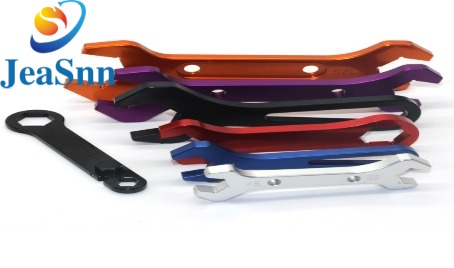
CNC machined aluminum industrial wrenches are custom mechanical tools and tool parts CNC milled in aluminum alloys.
So they are not pre-made wrenches, but the custom process that we use to design and build your one-off wrench is based on your detailed drawings, CAD model, physical dimensions, materials, and application needs. We mill down blank pieces of aluminum to form the shape and specific outlines of your custom-made wrench. With the aluminum and the machined cut path, we perform processes such as turning, drilling, tapping, and milling.
The above custom components include additional tooling, equipment adjusters, fixtures, as well as lightweight assemblies. Keep in mind that aluminum will not easily accept or resist hardened material. For a high-torque fastening system, material testing and engineering should be implemented. The overall design must meet the intended load, function, and safety application.
2. Why Choose Aluminum for Custom Industrial Wrenches?
Another popular CNC custom wrench material is aluminum. It's common to see aluminum as a CNC custom wrench material because it is lightweight, corrosion-resistant, and easily machinable.
The mechanical strength of aluminum is suitable, and the weight of the material is much lighter than steel, which makes the wrenches easier to operate by hand and less fatiguing when used over a long period of time. Actual working load capacity varies according to alloy and shape, and working torque.
Good to machine: Compared to other harder metals, it is easier to machine Aluminum. CNC Machining uses a variety of machining techniques to obtain high-quality, accurate shapes, smooth finishes, and complex structures, such as the body, handle, and adjusting parts of a wrench. Reduce lead time and improve efficiency.
Corrosion Resistance: The aluminum surface will readily form its own corrosion-resistant oxide coating for industrial environments with high humidity. Additionally, the aluminum surface can be anodized for additional protection as well as an enhancement of appearance. The anodized finish is designed to meet the application's needs.
CNC Machining covers all handle and connection sizes, slots, holes, and threads. Handle lengths, mounting configurations, and connection types can be personalized by engineers so you can meet the requirements of the equipment and operate tools and fixtures that are difficult to reach with ordinary wrenches.
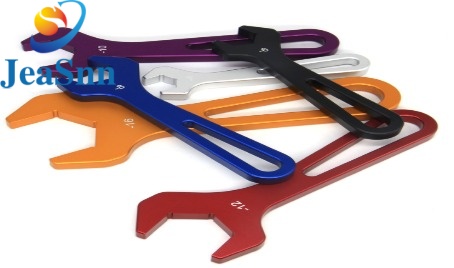
3. Choosing the Appropriate Aluminum Alloy for CNC Machined Wrenches
There are countless alloys used to produce custom CNC aluminum tools, and you should ensure you select the right one for your application. Each material has its own characteristics with regard to performance, corrosion, machinability, and heat-treat response.
6061-T6: Has a good balance of strength-to-weight ratio, machinability, corrosion resistance, and dimensional stability, and provides a wide range of possible surface finishes. Suitable for production use for mounting components, wrench bodies, and other general-purpose light-duty tooling.
7075-T6: Stronger in tensile strength than 6061-T6, used in high-load lightweight tool framing and precision brackets. It is not as corrosion resistant as 6061-T6 and may require additional surface coatings. 7075-T6 is more expensive to machine and weld.
Has excellent corrosion resistance and good formability. Cannot be used for heavily loaded wrench bodies, but can be used for protective covers, housings, and non-loaded tool accessories.
Note: choose alloys according to engineering analysis and actual working conditions. Hardened alloy steel is still the selected material for normal high-torque wrenches.
4. Design Factors for CNC Machined Aluminum Industrial Wrenches
Quality custom wrenches are highly machinable and exhibit good mechanical properties. Before being manufactured by CNC, the following points should be examined when CNC machining:
Torque and load sharing: Torque to be designed for maximum torque, total number of load cycles, location of stress concentration areas. Safety factors should be provided for overload failures (permanent deformation), proven through calculations and testing.
Handle torque and bending: Bigger handles. Focus on handle cross-section, thickness, and the shape of handle transition areas. Create contoured, lightweight handle profiles using CNC milling with slots and so on.
Jaws and contact surfaces. Increase the contact width of the jaw and contact surface profile and maintain the flatness/tolerance of the jaw to avoid slippage and damage to fastener, shape, and surface. When installing hard-wearing or abrasion-resistant steel inserts under heavy load time and time again.
Dimensional tolerances: Control needed dimensions (example: jaw opening, hole sizes). Maintain unshown feature dimensions to less aggressive tolerances, saving cost. First article sample testing and then production testing. When selecting the test sample, make sure they are representative of production.
Handle & Surface Finish: Facilitate an easy-to-grip, comfortable handle shape that is safe, anti-burr, and has an appropriate surface texture. Use a smooth edge and fine surface textures for safety and comfort.
5. CNC Machining Processes for Aluminum Industrial Wrenches
Suggested processes for custom aluminum wrenches could be based on part shape, order quantity, and quality.
CNC Milling: Ideal for the most complex geometries of the wrench. The cutting tools rotate and machine on flat, curved, jaws, slots, recesses, and other 3D features. Multi-axis milling enables machining from different angles.
CNC Turning: For rotation parts. Most mechanical wrench bodies come CNC milled, but you see threader adjuster, pin, shaft, cylindrical coupler, and bushing are most often CNC turned. Sometimes this is combined with milling for a completed assembly.
Machining using the drilling process, such as screw holes to attach fixtures and machining internal tapping on dovetails and other interchangeable or other adjustable inserts. The drawings need to show the position of the hole, thread precision, and the depth of thread engagement.
Decreases the number of re-fixturing of the workpiece required for parts with complex geometries that include angled and coned surfaces and complicated contours. Enhances productivity while holding tight positional tolerance of features.
6. Surface Finish of CNC Aluminum Wrenches
Not only the finish and the colour, but corrosion, wear behaviour, and their lifetimes are also of importance. Choose the finishing of the parts to suit the nature of the work and the material specification.
Anodizing: An electrochemical process used to produce a translucent, wear- and corrosion-resistant oxide surface, having a multitude of color choices for the best in aluminum tooling.
Hard anodizing: Adds a more substantial, harder layer of protection for wear. (Note that the hard anodize adds to size and needs to be included when designing parts.)
Sandblast: For an even, matte surface, and first step in stripping corrosion.
Optional for flat, shiny surfaces. Brushed has lines that texture the exposed surfaces.
Powder coating: tough in color, finishes to choose from, but keep in mind threads and close-fitting mating areas.
7. Quality Control for CNC Aluminum Parts
A good wrench can fail too. When the size, material, specs, and machining quality are inconsistent.
Aluminum alloy raw material inspection: the certification of grade, temper, batch traceability, mechanical properties, and other information of aluminum alloy should be inspected. The certification requirements shall be clarified before production.
Size, thickness, diameter of the hole, diameter of the threads, width of the jaw, flatness, parallelism, etc., using calipers, micrometers, thread gauges, CMM, etc.
Search for burrs, roughness, scratches, tool marks, coating flaws that might otherwise deprive the product of use or beauty.
"Tests and trials for static loading, tests and trials for deformation, endurance tests may also be conducted for the load- taking and load- breaking wrenches together with the dimensional inspection and the torque. The acceptance shall be fixed."
8. Manufacturing Mistakes and How to Dodge Them
Fair machining of the aluminium, but maybe more careful treatment will be required for more accurate machining.
Buckling of the workpiece results from the cutting heat and workpiece clamping stress or cutting force, or shape unevenness and the like. It can be prevented by workpiece fixture, cutting parameters, balance rate of the material removal, and reasonable machining sequence.
Burrs: Corners and hole intersections create burrs, which may affect assembly and be safety hazards. Use the correct tool, establish cutting parameters, and perform a separate deburring operation.
Tool/Dimensional mismatch: Tool wear, tool errors, bad fixture, positional errors. Must bring back tolerance by using true tools in manufacturing, fixturing, and in-line measurement.
Surface scratches and tool marks: Soft aluminum may be scratchy to process and handle. Use the correct tools and protective packaging.
Incorrect material: Only materials for machinability or only by price won't be strong enough. Consider strength, fatigue & corrosion resistance, and working load capacity in choosing the material.
9. Custom CNC Aluminum Manufacturing Beyond Industrial Wrenches
Most of the precision machined parts have similar engineering requirements as aluminum wrenches. Organize different precision custom parts from one supplier for easier project coordination. JeaSnn provides CNC services on metals and engineering plastics:
Aluminum, brass and stainless steel CNC machined fittings, connectors and corrosion resistance assemblies.
Plastic parts in POM, nylon, PTFE, ABS, PC and PEEK made by CNC
Custom fasteners: specialty nuts and screws with custom-made threads and heads
Precision shafts, bushings and standoff spacers for automation, electronics and mechanical assemblies.
A competent CNC manufacturer will bring all your sourcing under one roof and will provide consistent quality for all your custom hardware.
10. Selecting a Trustworthy CNC Aluminum Components Producer
Choosing the right CNC supplier is critical to the development of custom industrial parts. Here are some key factors to consider before working with them:
The supplier should possess extensive experience with aluminum alloys (particularly 6061, 7075, and 5052) and substantial expertise in complex part fabrication, including milling, turning, and tapping.
Ability to customize: Make sure they provide OEM and ODM, so they can build parts exactly to your drawings, samples, and technical specifications.
QC system: Standard workflows for inspection and dimensional checks should be provided. Requirements for inspection reports, certifications, and traceability of material should be clarified before delivery.
Surface finishing support: Preferred vendors will be able to support all finishing needs such as standard anodizing, hard anodizing, sand blasting, and polishing.
Engineering communication: Through an active, responsive technical team, you can prevent specification misinterpretation or surface out DFM improvements that reduce manufacturing complexity and cost.
Get in touch with Jea Snn Hardware for Custom CNC Machining
Searching for a custom CNC aluminum parts manufacturer, precision machined metal parts, or custom industrial hardware?
Please send us your drawing file, CAD, or project details to our engineering team for quoting.
Website: https://www.cncpartschina.com/
Email: engineer@cncpartschina.com
Phone / WhatsApp: +86 189 9805 7602
Get in touch today, and we'll talk through your CNC machining needs, bringing your engineering drawings to reality with precision manufacturing.