




 English

Light Emitting Diode (LED) technology has found its way into commercial, industrial, automotive, architectural, and exterior lighting applications. LED luminaires outperform conventional luminaires with respect to energy efficiency, longer operating hours, and expanded mechanical and optical flexibility. In order to unlock this expanded potential, the higher power density of LED technology requires meticulous design of luminaire thermal management and mechanical accuracy.
Aluminum housings and fixtures are used for high-end LED assemblies. Custom aluminum LED housings are made to house and protect internal electronics, support optics mechanically, and carry heat away from LED chips and driver circuits.
Although there are many sorts of aluminium, LED manufacturers need to choose the right one for their process, as well as optimize their aluminium fabrication process to ensure the precision of dimension tolerances. Improper heat transfer or finishing may influence the optical quality or fitting of the assembly. You can consider Precision Computer Numerical Control (CNC) Machining to take the stress of the task. Machining aluminium alloys through milling, turning, drilling, tapping, and multi-axis machining can provide LED light fixtures, heat sinks, mounting brackets, and light connectors customized to your needs.
Jea Snn is dedicated to providing OEM and ODM ultra-quality CNC aluminum lighting, electrical appliances, and industrial equipment. Equipped with Swiss and 5-axis machining centers, OEM and ODM LED aluminum parts can be used for customized LED lighting products and LED lighting OEM and ODM LED lighting components. In this tutorial, we cover everything from the selection of aluminum Materials, LED light fixture heatsink design, integration process, and manufacturing to OEM and ODM customized parts manufacturing.
1. What Are Custom Aluminum LED Fixtures?
Custom Aluminum LED Fixtures: Customized aluminum LED fixtures are components and housing assemblies that are machined from aluminum to suit the particular engineering and lighting application needs. Custom fixtures vary from standard housing units to accommodate the size of the product, power range, installation, and the optical design.
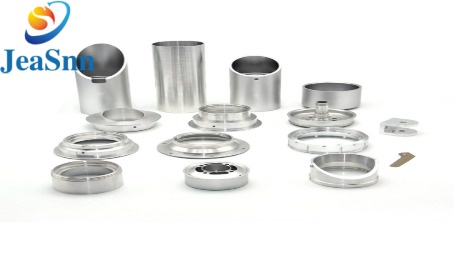
Typical applications for CNC-machined LED lighting components are covers to protect the LED module and circuit board, cooling devices that aid in removing heat from an LED chip, mounting brackets, connectors that join sections together, end caps, mounts for optical lenses and reflectors, pivoting components, and carefully machined spacers that keep uniform internal dimensions.
These parts can be used for building (architectural), building (commercial), landscape, stage, spotlight, track, automotive, and custom LED lighting fixtures. For OEM LED lighting manufacturers, the use of custom CNC LED parts and components allows for increased design flexibility with regard to overall geometry, mounting sizes, surface finishes, and mechanical integration, and will in turn result in a unique luminaire design.
2. Why Is Aluminum Widely Used in LED Fixture Manufacturing?
Aluminum is an ideal candidate for custom LED light elements thanks to a combination of low density, good thermal conductivity, corrosion resistance, and high machinability. It offers a good compromise of thermal performance, structural requirements, and manufacturing cost against other engineering metals.
Aluminum has excellent heat conductivity and quickly transfers the waste heat released by the LED chip. An increase in junction temperature will cause luminescence decay and reduce the service life of the LED chip without removal of heat. Aluminum material has good ductility, which can also be used in the design of various structural parts of lamps and lanterns, which can be optimized for lamps and lanterns.
As the softest metal commonly used in CNC Machining, aluminum is particularly simple to mill or turn on CNC equipment - giving you complex profiles, holes, and thread details for quick prototype and one-off development projects, as well as small batches of custom components. Aluminum's natural oxide coating provides modest corrosion resistance, which can be improved with anodizing, powder coating, and additional treatments for exterior or architectural lighting.
3. How to Select the Right Aluminum Alloy for LED Fixtures
Thermal objectives, physical strength, corrosion resistance, machinability, and budget all influence the alloys that go into the design.
6061-T6 is commonly the most popular alloy used in precision CNC lighting components due to its affordability, strength, corrosion resistance, and excellent anodizing properties. Its characteristics make it a superior alloy for many applications such as high-tolerance LED housing brackets, supporting brackets, fasteners, and hardware components. 6063 has the most desirable characteristics for extrusions and surface finishing, and as such, it is perhaps the most common alloy used in housing extrusions and fabricated heat sink profiles; it is still easy to secondary machine to allow for holes and threads. 5052 has a sheet-style composition with an excellent combination of corrosion resistance and formability, making it useful for enclosures and covers. 6082 has greater mechanical strength, making it more suitable for load-bearing construction lighting components. 7075 is considerably more expensive than 6061 and 6063, but it provides significantly greater mechanical strength and is recommended for only high-strength custom brackets and other specialty parts, as it is not suitable for thermally sensitive heat sinks. When selecting the proper grade for your lighting components, engineers should take factors such as thermal conduction, part design, and price into account.
4. Thermal Design Considerations for Custom Aluminum LED Fixtures
Thermal management is a major engineering challenge for the high-performance LED lighting industry. Well-designed aluminum LED housings can create an optimal heat transfer path from the LED module to the outside.
4.1 Understanding the LED Heat Transfer Path
Heat travels in sequence from the LED junction through the package, thermal interface material, metal-core PCB, aluminum heat spreader and/or housing, and finally to the ambient environment or mounting surface. Each connection in this sequence imposes a level of thermal resistance, and poor contact or inferior interface materials will diminish the overall heat transfer. Lighting designers should evaluate the entire thermal path, instead of focusing only on heat sink size.
4.2 Improving Heat Sink Geometry
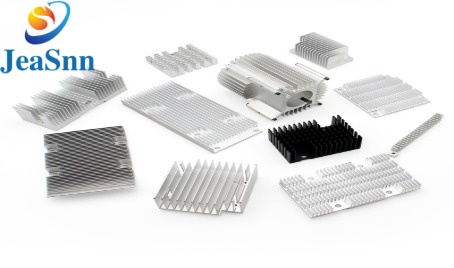
The thermoregulator geometry determines the surface exposed to heat exchange. Straight fins, radial fins, pin fins, circular sinks, and fins integrated into the enclosure can all be finished with different geometries based on the space available for installation, LED power, airflow, and production method. With CNC milling, custom fins can be shaped and manufactured more easily, which is especially effective for prototypes and special applications, but you might also want to consider the production cost and machining difficulty related to the use of ultra-thin fins with very narrow channels.
4.3 Take Fin Spacing and Airflow Into Account
Having packed fins does not necessarily result in good cooling, as they can interfere with natural convection if the gaps are too small. Engineers need to select the appropriate combination of parameters, including height, thickness, and spacing of the fins, and consider the orientation of fixtures and airflow on-site for successful passive cooling design.
4.4 Flat Surface of Thermal Contact
Flat contact surfaces are crucial to achieve flatness and low thermal contact resistance. CNC facing operation provides the same flatness of the LED mounting plane, the heat sink mating surface, and the locating surface. The required flatness and surface roughness are defined according to the selected thermal interface material and assembly scheme.
4.5 Factor in the Wall Thickness
Wall thicknesses need to be carefully balanced. Thin walls may deform during machining or assembly, whereas excessively thick parts add weight and cost with little thermal advantage. The ultimate wall thickness should be selected based on assembly and machining stability, heat transfer, fastener loads, and enclosure considerations.
4.6 Evaluating Thermal Expansion
Aluminum expands with increases in temperature. Changes in temperature can cause shifts in the relative positioning of the housing, PCB, lens, and fasteners. This is especially important to consider with long linear LED fixtures that use several different materials.
4.7 Considering Anodizing and Thermal Performance
Anodizing is used for surface finish (protective and aesthetic), and also influences the surface emissivity, which could also affect radiative heat transfer. But anodizing, in itself, is not expected to lead to dependable cooling improvement, so finishing should be considered at the outset of heat-sensitive LED fixture design.
5. CNC Machining Processes for Custom Aluminum LED Components
The large selection of LED lighting hardware requires CNC processing to meet its target shape, close tolerances, fine surface finish, and production rates. The research shows that CNC milling is an ideal process for diverse aluminum LED hardware. It can form the general shape of an outer contour, drill, mill, tap, machine the heat sink face, and form the various optical features of LED lighting hardware. CNC machining with milling may be the process of choice for multi-feature custom housings and multi-part support brackets. CNC turning offers the uniform bore, shoulders, and threads needed for cylindrical, symmetrical lighting hardware, such as the housing and end cap, the circular coupling, and a threaded fitting.
Additionally, 5-axis CNC machines can work on complex angled surfaces and non-uniform shapes, making them perfect for custom architectural lighting parts and adjustable fixture assemblies. Through CNC drilling and tapping we can produce accurate threaded holes for mounting and mounting hole dimensions, PCB fixation, lens retention, etc., in specifications such as thread size, thread depth, hole position, hole edge distance, drawing, etc., can be used. During new product development, prototype machining is used to check the size, fit, and the heat dissipation interface of each new product, and then the process is optimized for mass production. We can provide customized CNC processing according to drawings or samples for lamp manufacturers for pre-production and production.
6. Design for Manufacturing (DFM) Tips for Custom Aluminum LED Fixtures
Function and manufacturability: Sound LED fixture design should always integrate practicality and ease of manufacture. DFA (design for manufacturing) can be used to cut machining cycles and help produce quality, consistency, and cost-effectiveness.
Avoid complicated, fine detail - deep, narrow grooves and pockets inside walls that are hard to reach, unless they're necessary for your design's mechanical or thermal needs. Use liberal drill sizes, broad slots, and generous internal radii to avoid tiny drill diameters, which exponentially increase cut tool wear. Use tight tolerances only on features that need them, like mounting holes, features along the optical axis, and thermal interface features. Relax tolerances down to a lower cost range on the other features.
Design mounting holes and Threaded features to include access holes, thread engagement, wall thickness, edge clearances, and assembly clearances. Think early about the changes in dimensions when going to anodize or powder coat, and provide an appearance to prevent exposed threads as well as masking for optimum heat transfer. Join more than one small item into one machined assembly to reduce fasteners and assembly costs.
7. Why Choose JeaSnn for Custom CNC Aluminum LED Components?
A reliable lighting components supplier will always offer consistent quality, flexible customization, and a trusted source of manufacturing support. No matter which CNC machining supplier you are considering, it's usually better to choose one with years of experience, such as JeaSnn, which deals in CNC machining precision and custom metal hardware.
This is a part of JeaSnn's aluminum light manufacturing service, which provides LED housings, heat sinks, mounting brackets, end caps, connectors, spacers, and other machined parts. We can work with various aluminum grades such as 2024, 5052, 5083, 6061, 6061-T6, 6063, 6082, 7075, depending on the application, providing all the necessary strength, thermal, machining, and finishing properties.
Equipped with CNC milling, turning, Swiss machining, 5-axis machining, screw machining, and prototype Capabilities, we also offer assembly services. Backed by over 20 years of precision hardware expertise, our engineering team reviews drawings, 3D files, and samples for DFM assessment, material recommendation, and prototype tuning. We deliver cost-efficient aluminum lighting parts, tailored for custom housings, heat sinks, and mounting brackets to meet your unique specifications.
Contact JeaSnn – Custom CNC Aluminum LED Parts Manufacturer
Phone / WhatsApp: +86 189 9805 7602
Email: engineer@cncpartschina.com
Website: https://www.cncpartschina.com/
Discover how CNC machining, aluminum material selection, and thermal design improve custom LED fixtures. Explore precision aluminum housings, heat sinks, and lighting components.