



 English

While a nut may appear to be a basic fastener, its dimensional accuracy, thread quality, Material selection, mechanical strength, and surface finish directly govern the overall performance of finished OEM assemblies.
Standard nuts are suitable for applications conforming to conventional specifications. Even so, OEM producers frequently require custom CNC-machined nuts featuring non-standard sizes, special thread forms, unique geometries, tighter tolerances, or specialty materials. Where off-the-shelf nuts fail to meet required fit and functional criteria, custom-machined nuts serve as a vital component within engineered solutions.
JeaSnn is a specialist manufacturer of custom precision metal components including CNC-machined nuts, screws, shafts, bushings, spacers, and other custom fasteners. With over 20 years of heritage in precision hardware production, we deliver full support for OEM customers spanning prototype development to serial production.
What Are Custom CNC-Machined Nuts?
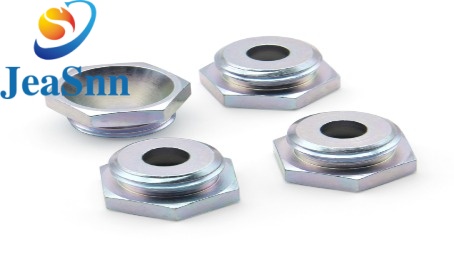
Custom CNC-machined nuts are fasteners fabricated to meet unique engineering specifications, instead of using readily available standard off-the-shelf nuts.
Design parameters for custom nuts vary based on application demands, covering:
Outer diameter
Overall height
Internal thread
Thread pitch
Thread tolerance
Material grade
Surface treatment
Head and body geometry
Internal & external features
Weight specifications
Assembly method
As an example, OEM equipment sometimes needs a nut with a specified internal thread yet a smaller outside diameter due to limited installation clearance. Other applications require thin nuts, flange nuts, slotted nuts, contoured special-profile nuts, or fasteners fabricated from corrosion-resistant stainless steel.
Such specifications can hardly be fulfilled by standard fastener products. Custom CNC machining enables nuts to be produced to match your real assembly conditions, rather than redesigning the assembly to fit a pre-made standard part.
Why Do OEM Manufacturers Need Custom Nuts?
OEM manufacturers often design products around specific dimensions and performance requirements.
Using a standard nut can create several problems:
The thread does not match the mating screw
The nut is too large for the available space
The thickness affects assembly dimensions
The material is unsuitable for the environment
The required strength is unavailable
The standard shape interferes with nearby components
The surface finish does not meet product requirements
A custom CNC nut can solve these problems by allowing engineers to control the important dimensions from the beginning.
This is particularly valuable for equipment manufacturers, robotics companies, automotive suppliers, electronics manufacturers, medical equipment producers, and industrial automation companies.
Precision Threading Is Critical for Custom Nuts
For a nut, the internal thread is one of the most important functional features.
Even when the outside dimensions are correct, poor thread accuracy can result in:
Difficult installation
Excessive clearance
Cross-threading
Insufficient engagement
Loosening during operation
Uneven load distribution
For this reason, precision custom nuts require controlled thread machining and inspection.
Depending on the design and production requirements, JeaSnn can support metric, inch, fine-pitch, coarse-pitch, UNC, UNF, and other custom thread specifications.
Thread gauges and dimensional inspection can be used to verify critical thread characteristics before shipment.
For OEM manufacturers, this is especially important when custom nuts must be assembled with existing custom CNC screws, shafts, bolts, or other precision components.
Materials for Custom CNC-Machined Nuts
Material selection should be based on the actual working environment rather than simply material price.
Stainless Steel Nuts
Stainless steel is frequently selected when corrosion resistance and durability are important.
Common options include:
303 stainless steel
304 stainless steel
316 stainless steel
410 stainless steel
303 stainless steel nuts are useful when machinability is an important consideration.
304 stainless steel nuts offer a widely used balance of corrosion resistance and mechanical performance.
316 stainless steel nuts are suitable for applications requiring higher corrosion resistance, including some outdoor, marine, and demanding industrial environments.
For OEM projects, the material grade should be specified clearly on the drawing or purchase specification.
Aluminum Nuts
Aluminum is useful when low weight is a priority.
Custom aluminum nuts can be used in:
Electronics
Robotics
Automotive components
Lightweight machinery
Aerospace-related assemblies
Aluminum can also receive surface treatments such as anodizing when required.
Brass Nuts
Brass provides good machinability and electrical conductivity.
It is commonly considered for:
Electrical equipment
Electronic assemblies
Sensors
Precision instruments
Decorative hardware
Carbon Steel and Alloy Steel Nuts
Carbon and alloy steel are selected for applications demanding high tensile strength and robust mechanical endurance.
Subject to design requirements, heat treatment and surface protection treatments may be implemented to enhance mechanical properties or boost corrosion resistance.
JeaSnn supports a broad range of metal materials for custom precision parts, including aluminum, stainless steel, steel, brass, copper, titanium, and other engineering materials
Types of Custom CNC Nuts
OEM applications rarely require only one standard nut design.
Depending on the assembly, custom nuts may include:
Custom Hex Nuts
Hex nuts are among the most common fasteners and can be customized in terms of width, height, thread, material, and strength.
Flange Nuts
A flange increases the contact area between the nut and mating surface.
This can help distribute fastening pressure and may eliminate the need for a separate washer in certain assemblies.
Thin Nuts
Thin or jam nuts are useful when installation space is limited.
Lock Nuts
Custom lock nuts can be designed for applications where resistance to loosening is required.
Slotted Nuts
Slotted configurations can be used in assemblies requiring mechanical locking features.
Special-Shaped Nuts
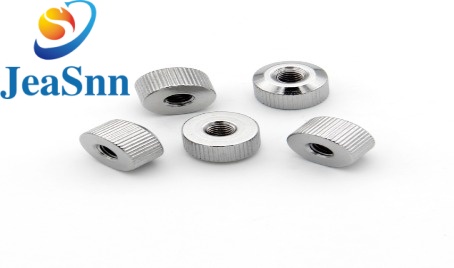
OEM assemblies can require components with square, rectangular, circular, knurled, stepped, or other bespoke geometries.
These represent typical application scenarios in which custom CNC-machined fasteners afford superior design flexibility relative to catalogue items.
When Should You Choose Custom CNC Nuts?
Custom nuts are particularly useful when:
1. Standard Dimensions Do Not Fit
If the standard nut is too large, too thick, or otherwise incompatible with the assembly, a custom design can solve the problem.
2. You Need a Special Thread
Metric and imperial threads are common, but some OEM products require unusual pitches, thread lengths, or special specifications.
3. Space Is Limited
Thin nuts, reduced-height nuts, or special-shaped nuts can help engineers optimize compact assemblies.
4. You Need a Specific Material
Different environments may require stainless steel, aluminum, brass, carbon steel, or alloy steel.
5. Tight Tolerances Are Required
Precision assemblies may require tighter dimensional control than typical commercial fasteners.
6. You Need Matching Custom Components
When a nut must work with a custom CNC screw or shaft, producing both components according to the same engineering requirements can simplify assembly control.
How CNC Machining Improves Custom Nut Accuracy
The advantage of CNC Machining is not simply automation. It is the ability to repeatedly manufacture complex dimensions according to digital engineering data.
A typical custom nut project may involve:
Engineering drawing review
Material confirmation
CNC process selection
Turning or milling
Thread machining
Deburring
Surface treatment
Dimensional inspection
Thread inspection
Final packaging
JeaSnn provides engineering and design support for OEM/ODM CNC machining projects and can review drawings, samples, and production requirements before manufacturing.
This process helps identify potential manufacturing issues before mass production begins.
Surface Finishing for Custom CNC Nuts
The correct surface treatment can improve appearance, corrosion resistance, wear resistance, or functional performance.
Depending on the material and application, possible finishes include:
Anodizing
Zinc plating
Nickel plating
Chrome plating
Electroless plating
Black oxide
Passivation
Polishing
Brushing
Heat treatment
Powder Coating
When prioritizing corrosion resistance and surface purity for stainless steel nuts, passivation treatment is a viable option.
For steel nuts, zinc plating or alternative protective coatings can be specified according to the service environment.
Surface treatment should always be evaluated together with thread tolerance because coating thickness can influence thread fit.
What Should You Provide When Ordering Custom CNC Nuts?
For an accurate quotation, OEM buyers should provide:
2D engineering drawing
3D CAD model
Material specification
Thread type
Thread pitch
Dimensions
Tolerance requirements
Surface finish
Heat treatment requirements
Quantity
Application information
If you already have a sample instead of a drawing, the supplier may also be able to evaluate the sample and help create a manufacturable drawing.
JeaSnn accepts common engineering file formats and provides drawing, sample, and design support for customized precision metal parts.
Why OEM Manufacturers Choose JeaSnn for Custom Nuts
Selecting a supplier for custom CNC nuts involves far more than just machining expertise.
OEM manufacturers generally seek a partner capable of delivering consistent quality while accommodating diverse material options, order volumes, tolerance requirements, and multi-stage production workflows.
JeaSnn has over twenty years of experience producing custom precision hardware. We provide a complete range of manufacturing processes such as CNC machining, CNC turning, screw machining, and CNC milling. Our QMS complies with ISO 9001:2015 and IATF 16949:2016.
Its custom nut manufacturing Capabilities cover different materials, thread specifications, dimensions, and non-standard designs. The company also supports prototype and production requirements, as well as related custom fasteners and precision metal components.
For an OEM project, this means you can discuss not only the nut itself, but also related custom parts, including screws, shafts, bushings, spacers, washers, and other CNC machined components.
Conclusion: Custom CNC Nuts for Precision OEM Applications
Small as a nut may seem, its performance is critical to the reliability of the whole mechanical assembly.
If standard nuts cannot fulfill your design needs, custom CNC-machined nuts offer greater flexibility in dimensions, threads, materials, tolerances, shapes, and surface treatments.
For OEM producers, a well-designed custom nut is not merely a low-cost fastener. It needs to match mating components perfectly, meet mechanical and environmental requirements, keep stable quality during production, and fit smoothly within the finished assembly.
JeaSnn manufactures custom CNC nuts, custom screws, precision shafts, bushings, spacers, washers, and other custom metal parts for OEM and industrial applications.
Should you need non-standard nuts, send your drawings, samples, or specs to JeaSnn for engineering review and a custom quote.
Email:engineer@cncpartschina.com
Need custom CNC-machined nuts for your next OEM application? Share your CAD drawings, material info, thread details, quantity, and tolerance requirements to get a quote.