


 English

For many types of heavy equipment, there is a clear need for robust and reliable locking of threaded fasteners. As mentioned above, vibration, impact, and variable temperatures will lead to progressive loss of preload with normal nuts. The various locking actions incorporated into metal lock nuts prevent this self-loosening.
There are also further considerations to be made regarding nut specification, e.g. tensile properties, thread form and size, fit, Material and coating, applied and working torques, etc. It is possible for a competent fabricator to manufacture bespoke nut sizes, thread forms and locking geometries based upon your engineering requirements.
At JeaSnn, we can supply a wide range of precision-fabricated products, such as lock nuts, set screws, shafts and bushes. Our process Capabilities encompass CNC, forged, cold-formed, and heat-treated parts to suit OEM and ODM customers. Here we provide some tips for choosing, assessing, and comparing different metal lock nuts prior to placing an order.
1. Definition of Custom Metal Lock Nut
The objective of any lock nut is to increase the likelihood that the nut will remain fixed on its engaged male thread following tightening. Obviously, a plain nut achieves this via the basic thread lock-up and generated preload alone. A lock nut provides an additional means of resisting the opposing rotational forces.
Metal lock nuts may be produced to meet almost any customer requirement. Some common examples of customization include:
Bespoke OD and nut height
Metric, Imperial (UNC, UNF) or other thread types and pitches
Modified locking action within the nut
Steel grades, coatings and other surface finishes
Flange and contact face geometry
Required and expected torque values
Dimensions
These features allow equipment builders to incorporate a suitable lock nut into their design to maximize fastener security.
What Factors Influence Fastener Loosening?
As detailed previously, the typical service life of equipment is compromised by a number of factors. In particular, repeated cross-thread motion due to vibration; varying levels of preload induced by fluctuating loads; impulsive forces (i.e., impact); temperature-induced elongation of components; and exposure to water, corrosive agents, and foreign bodies.
An appropriate choice of lock nut can mitigate each of these issues to some degree. However, as highlighted above, other parameters (including those relating to the associated bolt) must also be considered.
2. Common Types of Custom Metal Lock Nuts
Different lock nut types utilize individual anti-loosening methods - knowing the variations is the first step of selection.
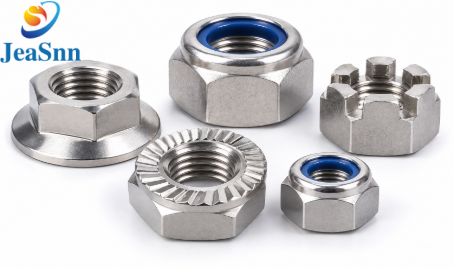
Nylon Insert Lock Nuts feature a nylon collar at the hole in the thread. When the bolt is inserted, the nylon flexes around the threads to produce a prevailing torque. Nylon insert lock nuts are quick to assemble, operate well in normal vibration, and are good for machinery, automotive, and Electrical use – but they aren't suited for high-temperature heavy equipment because of temperature and chemical limitations, and they can only be reused so many times.
All-Metal Lock Nuts apply drive-off and prevailing torque by either deformed thread area or special locking geometry and without the use of any polymers to wear out. All-Metal Lock Nuts are suitable for higher temperatures and harsh industrial assemblies. Their locking capacity is determined by design, material, and manufacturing precision.
Flange Lock Nuts provide an integrated flange that distributes the clamping load over a larger bearing surface; serrations increase the locking strength of the nut. Custom. For custom Flange Lock Nuts, the flange diameter, thickness, and serration geometry must be specified.
Prevailing Torque Lock Nuts sustain torque to rotation prior to ultimate tightening by deformation of the thread or locking features. Specifications: start and end torque, thread size, reusability, and environment.
Castellated Lock Nuts combine the slotted crowns with the drilled bolt and cotter pin for positive mechanical retention - perfect for axles, linkages, and rotating equipment.
JAM NUTS: Relatively thin nuts tightened against a full nut, preventing the combination from rotating. Most often used for threaded rod and mechanical adjustments.
Special-Geometry Custom Nuts: CNC machined with custom profiles, shoulders, grooves, or integrated features, SPM's special-geometry custom nuts are designed for maximum OEM flexibility when standard nuts don't do the job.
3. How to Select the Right Locking Mechanism
No lock nut suits every environment; selection depends on operating temperature, vibration intensity, maintenance frequency, installation space, and required locking performance.
Nylon insert nuts offer simple installation with prevailing torque for general machinery, but all-metal designs — using deformed threads — are better for the elevated temperatures typical of heavy equipment. Flange nuts spread load over a larger bearing area, suiting automotive and machinery assemblies, while castellated nuts with cotter pins provide positive mechanical locking for axles and rotating parts. Jam nuts suit adjustable positions on machinery and threaded rods, and custom prevailing-torque nuts deliver application-specific performance for specialized equipment.
In practice, avoid nylon inserts at high temperatures, match the mechanism to the vibration profile and preload, verify reusability where disassembly is frequent, confirm dimensional and tool clearances, and define torque requirements clearly before manufacturing.
4. How to Choose Material for Heavy Duty Custom Lock Nuts
The first question that you are likely thinking in your head is what material you should choose for heavy-duty custom lock nuts? Well, you asked the right question, because the material choice ultimately determines strength, corrosion resistance, wear properties, and service life.
You have options. JeaSnn will bring you stainless steel, carbon steel, alloy steel, aluminium, brass, titanium, and all sorts of engineering materials.
Here's the whole story: Carbon Steel (1018, 1045) has strength, machinability and economy, used for industrial machine components and construction equipment where zinc plating or black oxide may be specified. Alloy Steel (4140, SCM440) - Used in heat-treatable forms to provide increased strength and wear resistance for heavy-duty power transmission systems or high-load assemblies.
As for stainless steel, you still have a choice: For most uses, Grade 304 is fine; If you need something more resistant to seawater or chloride, use Grade 316; Grade 410 can be heat-treated for maximum strength and corrosion resistance; and Grade 303 has great machinability-just be sure it's not going to suffer thread galling, and use lube when assembling.
Aluminum (6061, 7075) has a very low weight, has good value for anodizing, and is ideal for building robots and light machines; however, the thread strength is not so good, so it can only be used for light-duty joints. Brass is ideal for machinability and electrical applications, and Titanium has a very high strength-to-weight ratio ideal for aerospace applications but is expensive and difficult to machine.
Therefore, your final selection must always agree with your original load, temperature, corrosion circumstances, the corresponding bolt material, and the locking efficiency to be achieved.
5. Thread Specifications: An Essential Element in Lock Nut Selection
Any lock nut - no matter how strong - will break if it doesn't have the right internal thread dimensions to fit your mating bolt.
Metric threads (M6-M24 and on) are used on most equipment around the world; each size can have several pitches, and the pitch on the part and thread must be exactly the same – coarse pitch M10 × 1.5 versus fine pitch M10 × 1.25, for instance. Inch-based UNC and UNF threads are found in American gear, automobile parts, and inch-spec parts.
Special & Non-Standard Threads – BSW, NPT, Left Hand and Custom Profiles Samples / Drawings should be supplied in order to provide a quotation. JeaSnn will accommodate any of these types of profile.
Lastly, the thread tolerance and fit are for easy engagement and the tightest fastening, controlled by the internal diameter, pitch, angle, depth, tolerance class, and surface roughness. The accuracy of precision lock nuts can be measured by thread gauges and various inspection processes.
6. Manufacturing Methods for Custom CNC Machined Lock Nuts
Manufacturing methods influence the precision, thread quality, mechanical properties, and price of custom lock nuts. Which is most suitable depends on the geometry, material, and number of items being ordered.
CNC Machining is suitable for more complex builds, unique sizes, and extremely tight tolerances- including external profiling, boring, thread cutting, grooving, and specific locking features- making it perfect for OEM components and prototypes as well as medium-volume runs. CNC turning creates round, coupling, and thin nuts with high accuracy, with CNC milling creating hex profiles, flats, and slots that wouldn't be possible with the turning process alone.
Cold heading and forging are processes used to form the metal through deformation and can be very fast with high output, producing no waste and consistent geometry, which makes it perfect for the production of simpler, standard-shaped nuts.
Threads may be cut (material removal) or rolled (plastic deformation, maximum strength when applicable); it is a choice depending on the specs, material, and number.
Surface treatment - zinc, nickel and chrome plating, black oxide, passivation, electropolishing, anodising (for aluminium) - improves corrosion resistance; the thickness of coatings must be monitored so that thread bores and internal fits are not compromised. Heat treatment - quenching and tempering of carbon and alloy steels - improves hardness and strength, checked as per engineering specifications.
7. DFM Tips: How to Optimize Custom Lock Nut Design
DFM is a powerful strategy to cut design complexity, control cost, and bring part quality to a new level. DFM is a powerful strategy to cut design complexity, control cost, and bring part quality to a new level. Take a minute before you send us that drawing to read up on just a few ideas for ensuring a smooth process.
Involve the locking device with the real requirement. Keep the choice - nylon insert, all-metal, flange or mechanical - matching the real vibration, temperature, load and maintenance conditions and not the presumed strength.
Provide actual thread diameter, pitch, standard, and tolerance if possible with a sample bolt or shaft. It would be especially helpful to have a sample bolt/shaft!
Specify outer diameter, width, and bearing surface, considering space for installation and forces involved. Use a simple shape to reduce machine expenses.
For critical dimensions, set tight tolerances where nothing can move, such as inside threads, bearing surfaces, locating diameters, and locking features.
Combine material and heat treatment as a single decision. For example, if an alloy steel nut requires higher hardness, it must have well-defined properties matched to the process.
And coatings! Plating can alter end size and inside threads, so be sure to mark that on your inspection.
And finally, submit a complete RFQ. Complete 2D drawings, 3D CAD model, specifications, and material grades- all those details. The more complete RFQ you send us, the more accurate we can quote!
8. Why Choose Jea Snn for Custom Metal Lock Nut Manufacturing?
Choosing the OEM manufacturing partner for the project is as important as choosing the perfect lock nut shape. Jea Snn is a hardware OEM ODM manufacturer supplier specializing in high-precision hardware manufacturing for more than 20 years.
Product Range
In addition to custom lock nuts, we also produce custom hex, flange, coupling, wing, knurled, thin, long, and full machining nuts, as well as special industrial nuts - all made to customer drawings, samples, and engineering specifications.
Materials
Our materials include stainless steel (303, 304, 316), carbon steel, alloy steel (4140, SCM440), aluminum (6061, 7075), brass and copper, titanium, and engineering plastics.
Manufacturing Capabilities
Production operations consist of: CNC machine and CNC turning and milling, automatic lathe and screw machine, cold heading and forging, thread cutting and rolling, heat treatment and surface treatment – a mixture that can handle fasteners for practically any structure or volume.
Experience - 20+ years working on custom precision hardware for industrial clients.
Standard-compliant quality - ISO 9001:2015 and IATF 16949:2016 systems guarantee our availability for continuous production and process control.
We accommodate flexible order sizes, covering prototype validation, low-batch trials, and large-scale OEM mass production.
We offer professional DFM consultation. Our skilled engineers assess your design for manufacturability and suggest DFM adjustments to optimize costs.
Broad customization choices: diverse materials and processing routes to align with your project specifications.
End-to-end manufacturing service: we produce CNC screws, precision shafts, bushings, lock nuts, standoffs, spacers, washers, and other custom specialty parts alongside lock nuts.
Whether you require custom non-standard lock nuts for heavy industrial machinery, stainless steel nuts for outdoor equipment, or alloy steel fasteners for industrial use, JeaSnn can evaluate your application demands and deliver feasible manufacturing solutions.
Contact JeaSnn – Custom Metal Lock Nut Manufacturer
Phone / WhatsApp: +86 189 9805 7602
Email: engineer@cncpartschina.com
Website: https://www.cncpartschina.com/